Lucky Hunter Payment Methods in Australia: AUD, Cards, Crypto and Banking
 Available in US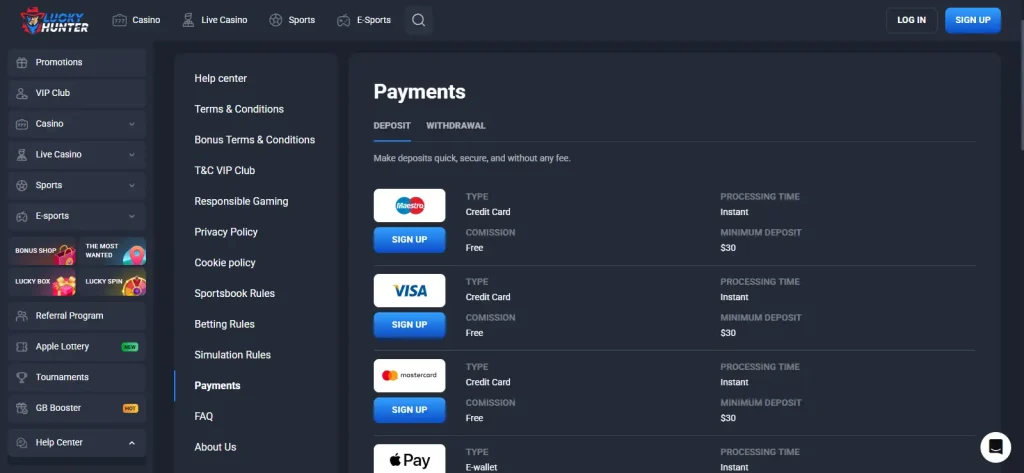
Lucky Hunter supports Australian dollars (AUD). The Australian-facing payment picture includes cards, e-wallet or voucher options and cryptocurrency for deposits, while bank transfer and cryptocurrency are represented among withdrawal routes. Exact cashier options can vary by account and location.
PayID is widely used in Australia, but Lucky Hunter’s public payments page does not list it among its payment methods. It is therefore not included as a standard Lucky Hunter option, while the cashier available to an individual account can still vary by location and account state.
Table of Contents
- Lucky Hunter payment options at a glance
- AUD support is the starting point, not the whole banking answer
- Deposit methods and account availability
- Crypto support is real, but it should not be framed as the Australian default
- PayID and Lucky Hunter account availability
- Deposits and withdrawals are different method sets
- Australian payment habits and Lucky Hunter methods
- Australia’s credit and digital-currency wagering ban is not a universal casino-payment rule
- How Lucky Hunter cashier availability varies
- Payments and bonus terms should stay separate
- What changes between deposit and withdrawal routes
- Bottom line
- Payment categories and account availability
Lucky Hunter payment options at a glance
| Payment question | Lucky Hunter detail | How to interpret it |
|---|---|---|
| Account currency | AUD is supported | Useful for reading balances and limits without assuming every method settles natively in AUD |
| Deposit categories | Cards, e-wallet or voucher options and cryptocurrency | The exact brand list can vary by account and location |
| Withdrawal categories | Bank transfer and cryptocurrency are listed for AU users | Method eligibility and settlement times vary by account and payment rail |
| Crypto assets | BTC, ETH, LTC, BCH, DOG and USDT are in the official currency list | Support does not make crypto a mainstream Australian consumer payment method |
| PayID | PayID is not listed on Lucky Hunter’s public payments page | Not listed as a standard Lucky Hunter method |
The important distinction is between common Australian payment habits, Lucky Hunter’s global payment catalogue and the methods actually offered to a particular account. Local popularity alone does not establish Lucky Hunter support for a method such as PayID.
AUD support is the starting point, not the whole banking answer
The official Lucky Hunter AU Terms and Conditions list AUD alongside other fiat and cryptocurrency currencies. For an Australian reader, that matters because an AUD account reduces the need to mentally translate every balance into another fiat currency. It does not prove that every underlying payment rail is domestic, that every card will be accepted, or that external processors cannot perform their own currency conversion.
Lucky Hunter’s terms say the website’s internal operating currency is euro and note that card transactions in other currencies can involve conversion by a bank or payment processor. AUD can therefore be an account currency while a payment rail still introduces conversion conditions.
AUD selection is handled at account level, while payment methods depend on the cashier and the route available to the account. The account section covers registration and currency setup.
Deposit methods and account availability
Lucky Hunter’s public payments page displays Visa, Mastercard, Maestro, e-wallets, vouchers and several cryptocurrencies. Australian account availability can be narrower because methods can depend on location, issuer, processor and account status. Cards, e-wallet or voucher options and cryptocurrency remain the main deposit categories identified for the Australian-facing service.
A global payments catalogue can contain methods that depend on location, issuer or processor. AUD support does not guarantee that every globally listed payment brand is available to every Australian account.
Deposit speed and fees can depend on the payment method, issuer, network and account state. A method described as immediate at one stage can still be affected by issuer acceptance, account controls or network settlement.
Crypto support is real, but it should not be framed as the Australian default
The official AU terms include BTC, ETH, LTC, BCH, DOG and USDT in the accepted currency list, and the public payments page shows matching crypto methods. This supports a direct statement that Lucky Hunter includes major cryptocurrency options in its payment set.
Australian consumer behaviour provides a useful counterweight to casino-industry visibility. The Reserve Bank of Australia’s 2025 Consumer Payments Survey found that cryptocurrency payment use remained low in the general market, with only around 2 percent of respondents saying they had used cryptocurrency to make a payment in the previous year. By contrast, cards remained dominant across Australian consumer payments.
So crypto can be prominent on an offshore casino cashier without being a mainstream Australian payment habit. That is a better interpretation than presenting crypto as automatically faster, safer, cheaper or more normal for Australian users. Those comparative claims depend on the specific rail, network and account checks and are not established by the fact that a crypto option exists.
PayID and Lucky Hunter account availability
PayID is widely recognised in Australia, but Lucky Hunter’s public payments page does not list it among its payment methods. It is therefore not included as a standard Lucky Hunter option for Australian accounts. Account-level cashier availability can differ, but Australian popularity alone does not make PayID part of the brand’s stated method set.
PayID is widely used in Australia, but Lucky Hunter’s public payments page does not list it. Australian third-party reports also disagree about its availability. The practical position is therefore that PayID should not be assumed for a Lucky Hunter account; the cashier shown to that account determines whether it is available.
PayID should neither be presented as a standard Lucky Hunter method nor ruled out for every possible account state. Australian popularity does not by itself create brand support, and the public Lucky Hunter method list currently omits it.
Deposits and withdrawals are different method sets
Deposit and withdrawal method sets are not necessarily identical. Australian-facing payment information lists bank transfer and cryptocurrency among withdrawal categories, while deposit categories are broader and include cards plus e-wallet or voucher options. Lucky Hunter also reserves the ability to use a different payout route when necessary.
That split matters most when someone chooses a deposit method based only on convenience. The method used to fund an account does not by itself establish how a later withdrawal will be returned. Account verification, method eligibility and the operator’s payout rules can affect the route.
Withdrawal processing windows and weekly or monthly limits sit with the cashout rules rather than the deposit-method summary. The withdrawals section covers the casino-side processing window, standard limits and KYC dependencies.
Australian payment habits and Lucky Hunter methods
The RBA’s 2025 consumer-payments data shows cards remained the dominant payment method in Australia, while PayID awareness and use also increased. That national pattern helps explain why Australian users may expect cards and PayID, but Lucky Hunter’s own method set remains separate from general Australian payment habits.
National payment habits and Lucky Hunter cashier availability are separate. Cards are common in Australia, but issuer acceptance can vary for an offshore merchant. PayID is widely recognised, while Lucky Hunter’s public payment-method list does not include it. Bank-transfer routing and settlement conditions can also depend on the operator and processor.
Lucky Hunter supports AUD and identifies cards, e-wallet or voucher options and cryptocurrencies among deposit categories. Bank transfer and cryptocurrency appear among withdrawal routes. PayID is not listed on the public payments page.
How Lucky Hunter cashier availability varies
- Account currency: AUD is supported, while payment-rail conversion can still occur in some circumstances.
- Deposit and withdrawal methods: the available method sets can differ.
- Account availability: individual payment brands can depend on location, issuer, processor and account status.
- PayID: it is not listed on Lucky Hunter’s public payments page and is not included as a standard method.
- Speed and fees: these can depend on the payment rail and account conditions.
- Withdrawals: processing windows, limits and KYC dependencies sit under the cashout rules.
Payment choice is separate from the question of which methods are actually available to an account. Cards, e-wallets, vouchers, bank transfer and crypto also have different settlement and account requirements.
Payments and bonus terms should stay separate
Payment method availability and bonus eligibility are separate unless a promotion links them. A bonus can impose its own minimum deposit or qualifying-payment conditions, while the cashier controls which deposit and withdrawal routes are available to the account.
Identity checks can affect withdrawals, while deposit-method availability, payout-route eligibility and KYC remain separate account conditions. A change in one of those areas does not automatically change the others.
What changes between deposit and withdrawal routes
A method shown for deposits is not automatically available for withdrawals. Lucky Hunter’s Australian-facing payment information is broader on the deposit side, while bank transfer and cryptocurrency appear among withdrawal categories. The account cashier and the operator’s payout rules determine the route actually available.
That difference is especially important when AUD is the account currency. AUD support describes the account denomination; it does not mean every payment rail settles directly in AUD or that every global payment brand is offered to the account. Cards, e-wallet or voucher options and crypto are category-level descriptions, not a promise of one identical cashier for all users.
Lucky Hunter also lists several major cryptocurrencies in its payment terms, including BTC, ETH, LTC, BCH, DOGE and USDT. Crypto support belongs to the same account-level availability rule as cards and e-wallets: the category can be supported while the exact route shown to an individual account differs. Bank transfer and cryptocurrency are also represented among withdrawal routes.
Australia’s credit and digital-currency restrictions apply to regulated interactive wagering services and should not be treated as a universal description of every offshore casino payment rail. Lucky Hunter’s casino payment options therefore need to be read separately from the rules that apply to Australian licensed wagering providers.
Cashout stages, standard limits and method-dependent timing are covered under withdrawals.
AUD selection and the one-account conditions sit with account setup.
Identity-related withdrawal holds sit with KYC.
Promotional balances can add separate bonus terms to the ordinary payment rules.
Bottom line
Lucky Hunter supports AUD and presents card, e-wallet or voucher and cryptocurrency deposit categories, with bank transfer and cryptocurrency among withdrawal routes. Those categories describe the broad payment picture, while exact method availability can vary by account.
PayID is popular in Australia, but Lucky Hunter’s public payments page does not list it as a standard method. Account-level cashier availability can still vary. For payout mechanics use the withdrawal guide, and for the wider site context return to the Lucky Hunter Australia review.
Payment categories and account availability
AUD support, card options, e-wallet or voucher categories and cryptocurrency describe the broad deposit picture. Bank transfer and cryptocurrency are among the withdrawal routes. PayID is not listed on Lucky Hunter’s public payments page and is not included as a standard method.
The withdrawal rules page covers payout processing and limits, while KYC covers identity-related account holds.